Comment fonctionnent les batteries au lithium-ion

Many people in the construction industry understand the basics of how internal combustion engines work - but what about the batteries used to power electric construction equipment? Now's a great time to learn since battery-electric machines are becoming more common on jobsites.
Most electric vehicles - like cars and Volvo electric machines - use lithium-ion batteries, which are rechargeable batteries also used in electronic devices such as mobile phones, laptops and more. They're called "lithium-ion" because lithium ions move between two electrodes during the charging and discharging cycles to store and release energy.
Let's take a deeper look at what makes up a lithium-ion battery and how the components inside work.
THE COMPONENTS OF A LITHIUM-ION BATTERY
First off, electricity can't be captured and stored. It must be converted into another energy form (e.g chemical energy) which can then be stored.
Batteries are like fuel tanks - they don't produce energy, but rather store it. In an internal combustion engine, the bond energies within gasoline or diesel molecules are broken and converted to heat, which in turn transforms into the mechanical energy needed to drive the piston inside the engine. Similarly, batteries store electricity from the power grid in the form of chemical potential and then discharge that energy to provide electricity when it's needed.
Lithium-ion batteries contain four major components:
1. Anode (-)
2. Cathode (+)
3. Electrolyte
4. Separator
A battery must be connected to an external circuit (e.g. an electric machine or a mobile phone, as examples) to absorb and release energy. Electrons are the energy that provide the power. They move from the anode through the external circuit to the cathode while lithium ions stay inside the battery and move through the electrolyte to the other side - we'll explain this more in a bit.
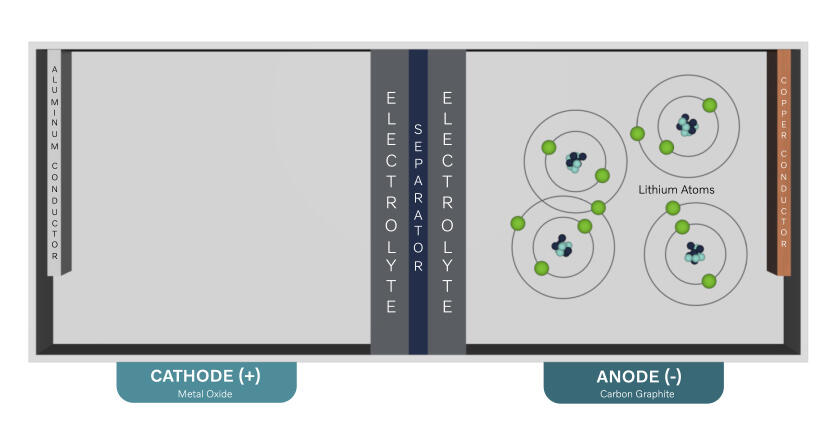
First, what are anodes, cathodes, separators and electrolytes? Let's take a look:
- The anode (the negative end) is the "giver" in the battery. It releases or "gives" electrons and lithium ions to the cathode during discharge, and then it takes them back during charging. Anodes are typically made of carbon graphite because it arranges and stores lithium in an optimized state.
- The cathode (the positive end) is the "receiver" of the battery. It receives lithium ions during discharge, and then releases them during charging. Cathodes are typically made of metal-oxides [e.g., NMC (nickel, manganese and cobalt oxide), NCA (nickel, cobalt and aluminum) or LFP (lithium, iron and phosphate)] that want to take on available electrons.
- The electrolyte is a chemical solution (e.g. a liquid) between the anode and cathode that allows lithium ions to transfer back and forth between the anode and cathode.
- The separator is non-conductive, semipermeable and divides the anode and cathode. It allows only lithium-ions to pass through - it prevents electrons from doing the same. The electrons take a different path to the other side (through the external circuit that powers a machine or device). This selective permeability is crucial for the battery's function and safety, as it prevents short circuits and ensures efficient energy storage and release.
- Note: The separator is what keeps the chemical reactions inside a lithium-ion battery from getting out of control. This is why you're always asked not to check lithium batteries on a plane.
WHY LITHIUM IS USED IN MOST RECHARGEABLE BATTERIES
Lithium is popular because it's incredibly reactive and can store a lot of energy. This reactivity allows lithium-ion batteries to be small and lightweight, yet powerful - which is ideal for portable electronics and electric vehicles.
On the periodic table of elements, you'll notice that Lithium is #3, meaning it has three protons (+) in its nucleus and three electrons (-) arranged in two "shells" around the nucleus - this electron arrangement is the key.
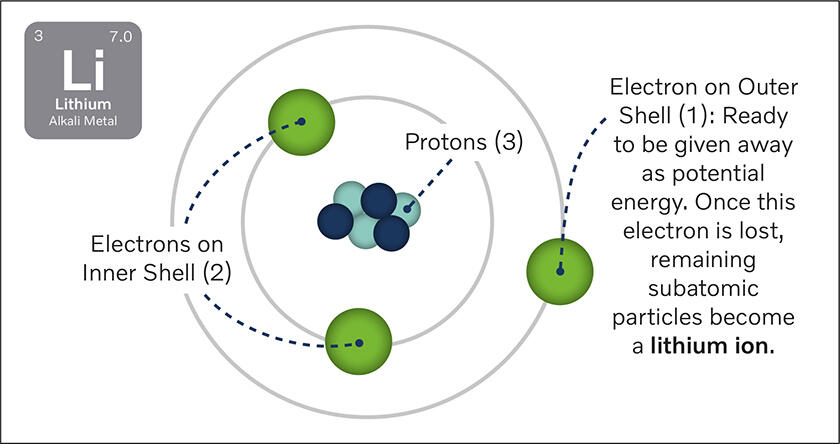
The first shell holds two electrons - further out, the second shell holds one. This single electron in the outer shell makes lithium highly reactive, as it wants to lose this electron to achieve a more stable configuration.
When lithium loses its electron, the remaining subatomic particles become what's called an ion. An ion is simply an atom that has an electric charge because it either gained electrons, making it negatively charged, or lost electrons, making it positively charged. In this case, lithium loses an electron and becomes a positively charged lithium ion. This is where lithium-ion batteries get their name.
So, where do these lost electrons and newly formed lithium ions go?
HOW LITHIUM-ION BATTERIES WORK
To explain what's happening, we'll use the NMC (nickel, manganese and cobalt oxide) battery configuration on an electric machine as our example:
- To start, a battery is fully charged and not connected to a machine. The transfer of molecules that creates energy from the anode to the cathode cannot begin until they're connected via a circuit - in this case, when the battery is turned on and the machine is being used.
- While the battery is discharging during use, lithium ions move from the anode (negative side) to the cathode - remember, the cathode wants electrons, and the lithium in the anode wants to give them up. This flow of electrons from the anode to the cathode is forced through the circuitry of the machine to power it. The electrons facilitate the transfer of energy from the battery to the machine, but they themselves do not get consumed.
- To help bring electrons over to the cathode, a conductive aluminum layer is added to this side.
- The electrons moving to the positive side of the battery start to build up a negative charge in the cathode - and electrons, which are negative, don't like to move toward a negative environment. Remember, opposites attract - so to keep the reaction going, the anode simultaneously releases positive lithium ions to the cathode through the electrolyte inside the battery.
Once most of the lithium has moved from the anode to the cathode during discharge, the battery is empty.
DÉCHARGE : LES IONS LITHIUM ET LES ÉLECTRONS SE DÉPLACENT DE L'ANODE VERS LA CATHODE
CHARGE : LES IONS LITHIUM ET LES ÉLECTRONS SE DÉPLACENT DE LA CATHODE VERS L'ANODE
- Ensuite, lorsque vous branchez l'appareil à une source d'alimentation externe pour le recharger, les électrons du côté de la cathode sont renvoyés vers le côté de l'anode, d'où ils sont partis. En conséquence, les ions lithium traversent à nouveau l'électrolyte et le séparateur pour retourner à l'anode, créant ainsi un système équilibré. Ce qui se passe pendant la charge de la machine est simplement l'inverse de ce qui se passe pendant la décharge.
- Pour aider à ramener les électrons vers l'anode, une couche de cuivre conductrice est ajoutée à ce côté.
- Ce sont ces réactions opposées qui rendent les batteries au lithium-ion rechargeables.
Cependant, au fil du temps, la nature irréversible du processus peut modifier la composition chimique et la structure des matériaux de la batterie, ce qui, à son tour, peut réduire la durée de vie et les performances de celle-ci.
POURQUOI NOUS UTILISONS DES BATTERIES AU LITHIUM-ION NMC CHEZ VOLVO
Il convient également de noter que les différents types de batteries au lithium-ion présentent des compositions chimiques légèrement différentes. Cependant, elles reposent toutes sur le mouvement des électrons et des ions lithium entre les électrodes pour stocker et libérer de l'énergie.
Les types de batteries les plus courants sont les batteries au plomb-acide, au nickel et au lithium-ion. Il existe quelques types différents de batteries au lithium-ion, en fonction du matériau à partir duquel elles sont fabriquées. Chez Volvo, nous utilisons actuellement des NMC (oxydes de nickel, manganèse et cobalt) car ils :
- ont la plus grande maturité technologique
- sont actuellement les plus faciles à fabriquer
- ont une densité énergétique élevée
- offrent une longue durée de vie à la batterie
- sont une option plus sûre par rapport à certaines autres configuration
- peuvent être recyclés
Les batteries au lithium-ion sont supérieures aux batteries au plomb-acide car elles :
- ont une densité énergétique trois fois supérieure
- doublent la durée de vie de la batterie
- ont systématiquement des performances supérieures dans les applications à haute température
- se chargent rapidement
- n'ont aucun effet mémoire et ne nécessitent aucun entretien
Parmi les batteries au lithium-ion, les batteries NMC offrent de meilleures capacités de charge rapide, de meilleures performances par temps froid et une densité énergétique plus élevée que les batteries LFP.
CONSEILS DE CHARGE POUR LES BATTERIES AU LITHIUM-ION DANS UN ÉQUIPEMENT DE CONSTRUCTION ÉLECTRIQUE
Si vous possédez des équipements électriques lourds, voici quelques conseils pour vous aider à disposer d'une puissance suffisante lorsque vous en avez besoin et pour limiter la dégradation de la batterie au fil du temps :
- Maintenez la machine électrique à environ 90 % de son état de charge et évitez de la recharger trop souvent à 100 %.
- Évitez de laisser la batterie se décharger trop profondément. Si possible, ne laissez pas votre batterie se décharger complètement jusqu'à 0 %.
- Si vous ne comptez pas utiliser votre machine électrique pendant une période prolongée, maintenez-la à environ 40-50 % de sa charge (une batterie complètement chargée présente un taux d'autodécharge plus élevé).
- Essayez d'utiliser un chargeur lent CA au moins une fois par semaine et laissez le système de gestion des batteries (BMS) équilibrer les packs de batteries.
- Programmez la température de votre machine à l'avance, particulièrement pendant les froides journées d'hiver. Cela peut impliquer de réchauffer le pack batteries ou la machine pour atteindre une plage de températures appropriée, afin d'améliorer l'efficacité du processus de recharge. Grâce au préconditionnement, la température interne de la batterie est amenée à un niveau idéal, ce qui permet une recharge plus efficace et prolonge potentiellement la durée de vie globale de la batterie.
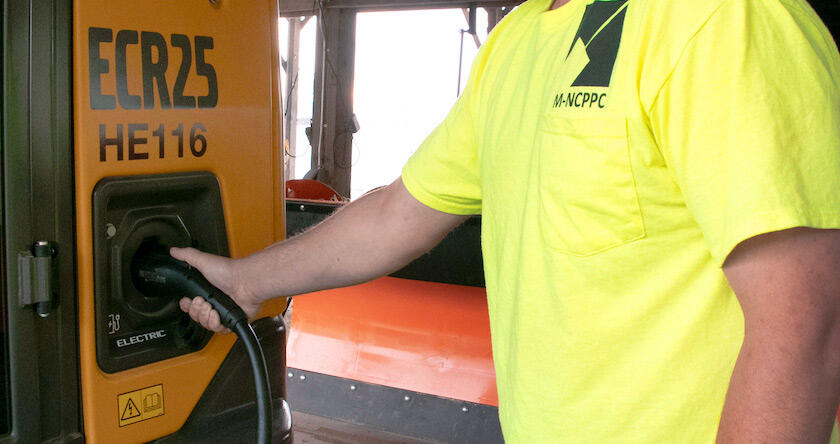
Notez que pour l'équipement électrique Volvo, la fenêtre SOC est comprise entre 10 % et 90 %, contrairement aux voitures où la fenêtre SOC est plus large. Une machine électrique affichant un SOC de 0 % correspond en réalité à 10 % pour la batterie, et un SOC de 100 % correspond en réalité à 90 %.
Nous reconnaissons que tout cela peut encore sembler un peu compliqué, mais cela s'explique en grande partie par le fait que ce domaine est encore relativement nouveau dans notre secteur. Imaginez à quel point il peut être déroutant pour un novice d'apprendre comment fonctionne un moteur à combustion interne. Avec le temps et l'expérience, cependant, tout commence à faire sens, et ce sera également le cas ici.
Si vous souhaitez découvrir les performances des machines électriques, contactez votre concessionnaire Volvo local. Il peut vous accompagner ou même utiliser une machine afin que vous compreniez mieux comment elles offrent la même puissance et les mêmes performances que les modèles diesel comparables.


