How Volvo CE develops and tests construction machines for the real world

For Mats Sköldberg, Head of Technology at Volvo CE, that rigorous approach is essential. Customers depend on their machines to perform reliably, safely and productively, wherever they work, and meeting that expectation starts long before a machine reaches the jobsite.
The tools are changing. Simulation now carries more of the early validation work, and customers are involved earlier in development. But the final test has not changed. Every new machine still has to prove itself in real operating conditions.
Testing machines in extreme heat, cold and on slopes
One of the first challenges machines face is climate testing. Volvo CE engineers assess cold-start performance, heating and cooling systems and overall reliability in extreme environments, with winter testing carried out in cold weather locations around the world, including northern Sweden and northern China and hot-climate testing in environments like southern Spain and southern China.
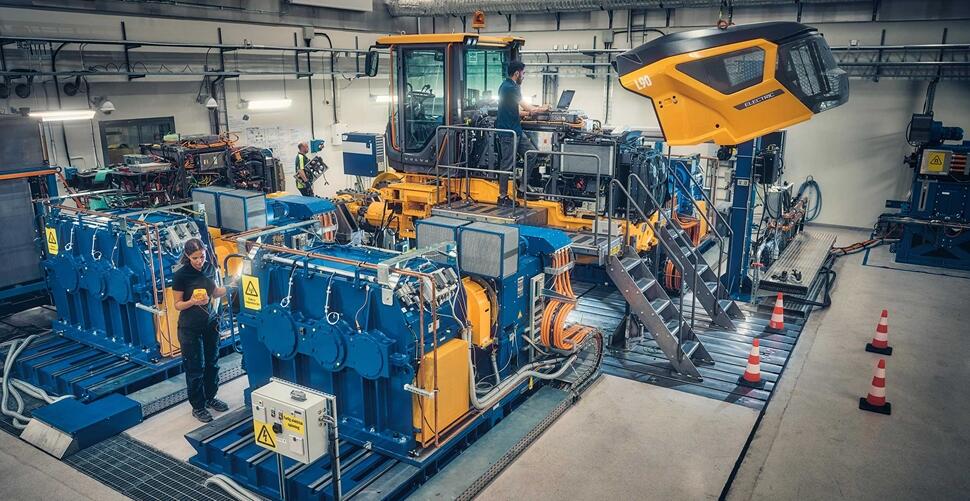
Engineers also run accelerated durability tests, operating machines at full load and high intensity. This exposes potential weaknesses far more quickly than would be possible through normal customer use, so teams can learn faster and improve designs earlier.
Stability is another critical area. On a tilt platform, engineers determine the angle at which a machine approaches its limits and verify that it performs safely under challenging conditions. Electromagnetic compatibility (EMC) testing checks that machines can withstand electromagnetic interference and do not generate excessive interference themselves.
Every key function is verified, from emergency stop systems and safety features to transmissions, differential functions and gear shifting.
Software now gets the same scrutiny. As machines become more connected and electronically controlled, Volvo CE tests and validates software, electronics, hydraulics and mechanical systems to ensure they work reliably together across a wide range of operating conditions.
The final proving ground is the customer's site. A significant part of Volvo CE’s testing takes place with customers in real operating conditions, showing engineers how machines perform in everyday use and bringing back feedback from the people who operate them.
Why virtual testing means fewer physical prototypes
Simulation and virtual testing have been part of Volvo CE’s R&D for many years, and they are taking on more of the work.
 “How much can be done digitally depends on the type and scope of the development project, but in general we are able to verify and validate designs before moving to physical prototypes,” explains Mats. “This enables us to identify potential issues earlier, learn faster and make more informed decisions throughout the development process.”
Wheel loaders are a good example. In some development projects, Volvo CE has reduced the number of physical builds from around three or four to between one and three. Engineers can complete more validation work in the virtual environment while gaining valuable insights before committing to a physical machine.
“At the same time, physical testing remains an essential part of the development process,” says Mats. “While digital tools help us evaluate and optimize designs earlier and more efficiently, ultimately machines need to be validated in real operating conditions with customers.”
Putting customers at the heart of development
Customers and operators have always played a central role in shaping Volvo CE machines, from the earliest stages of development through to testing.
Volvo CE gathers their insight from several sources, including customer interviews, customer clinics, market organizations and colleagues with deep knowledge of specific applications and industries. Together, they help Volvo CE understand how equipment is used in different parts of the world and where it can deliver the most value.
Volvo CE is now involving customers earlier and more continuously throughout the development process. “This gives us more opportunities to test assumptions, learn throughout the project and make adjustments along the way, helping to ensure that new products and features address genuine customer needs,” says Mats.
That feedback can directly influence the finished machine. Operator insight on visibility, ergonomics, ease of operation and usability can lead to design changes and feature adjustments. More broadly, it helps Volvo CE prioritize the improvements that deliver the most value to customers.
Why innovation must work in the real world
“We do not see innovation as competing with practicality, serviceability or affordability. For us, innovation is about improving exactly these areas,” says Mats.
Volvo CE’s aim is to develop solutions that improve productivity, efficiency and uptime while reducing the total cost of ownership.
“Innovation only creates value when it performs reliably in the real world and supports customers' businesses,” he says.
How the skills behind the machines are changing
As machines evolve, so do the teams developing them. Mechanical, hydraulic and structural engineering remain fundamental. Volvo CE increasingly complements them with expertise in software, electronics, connectivity and systems integration.
The move towards electromobility and more sustainable solutions has added demand for skills in battery and technologies, electric drivetrains, energy management and charging solutions. Development is also more cross-functional, which puts more weight on digital skills, collaboration and continuous learning.
Mats says Volvo CE needs “both deep specialist expertise and people who can understand how their area connects with other technologies and disciplines across the complete machine.”
From virtual simulations and climate testing to customer jobsites, that combination of expertise technology and real-world insight is how Volvo CE turns a concept into a machine customers can rely on.