Volvo L120 Electric delivers construction decarbonization in UK debut

Volvo Group and global building materials company Heidelberg Materials have been engaged in a formal collaboration since 2023, investigating solutions to reduce carbon emissions in the construction sector.
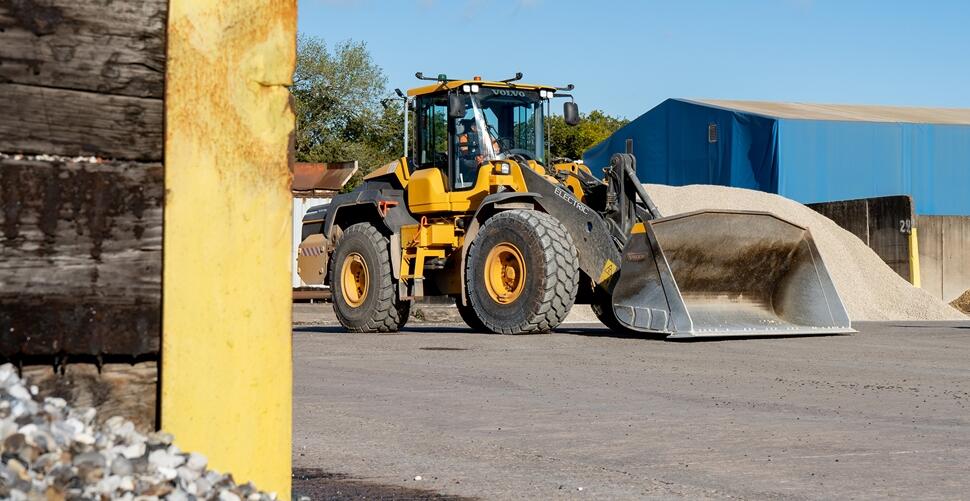
This latest step sees the zero-emission L120 Electric replace a diesel wheel loader at Heidelberg Materials UK’s main aggregates bagging facility in Nuneaton – the very first use of the battery electric machine in the UK, and the first fully electric heavy mobile equipment for Heidelberg Materials UK.
Volvo CE dealer SMT Great Britain has played a vital role in setting up the customer for success, not only ensuring the infrastructure is in place but also delivering on-site training for operators, enabling customers to transform with ease.
Pioneering and productive electrification
Darren Fitch, Head of Strategic Accounts, Volvo CE, says: “We at Volvo CE are committed to continuing to develop low carbon technologies that help our strategic partners achieve their decarbonization targets at competitive total cost of ownership (TCO) levels. By working closely together with Heidelberg Materials, we are able to ensure that all stakeholders at an operational level see that transformation is possible with positive impact on productivity and uptime.”
Heidelberg Materials aligns closely with Volvo CE’s sustainability ambitions, having set itself strict targets to reach net zero greenhouse gas emissions across its value chain, involving both its product roadmap and its own operations.
Marian Garfield, Sustainability Director at Heidelberg Materials UK says: “Switching from diesel to electric machinery and vehicles is an important part of our commitment to decarbonise our operations and reach our 2050 net zero goals and the L120 Electric represents a big step forward for us.”
 Marian Garfield, Sustainability Director at Heidelberg Materials UK
Supporting a sustainable transformation with a total solution approach
The L120 Electric is used for material handling at the site, moving materials from one point to another within the production process. It typically fulfills a 7.5 hour shift on just one charge with 30% left on the battery.
It is being powered by both a slow charger, for an overnight top-up, and a 150kW fast charger, which provides a 1.5-hour ‘opportunity charge’ whenever needed during the day so the machine can continue to deliver on more intense tasks.
Value chain collaboration to ensure smooth implementation
The project is a testament to the power of collaboration and is providing valuable learnings on how to integrate sustainable solutions into real-world sites, particularly into the complex world of quarry and mining.
It has highlighted the need for early collaboration across the supply chain to ensure the successful implementation of electrification, particularly when it comes to setting up sufficient charging infrastructure.
Shaun Sisterson, eMobility Business Manager at SMT GB, says: “One of the most important considerations has been charging infrastructure set-up, highlighting a need for early discussions, site visits and collaboration across multiple players before a machine comes to site. Until a fast charger was able to be installed, we set up an intermediary solution of a slower overnight charger, ensuring Heidelberg Materials could get the machine as soon as possible, driver training and familiarization could happen, and the site meets its performance requirements.”
 Shaun Sisterson, eMobility Business Manager at SMT GB
To ensure the electric machine is operating as efficiently as possible, SMT GB demonstrator Shaun Greer worked closely alongside four of Heidelberg Materials’ operators. He helped them to navigate battery capacity and charging longevity so that they could deliver an optimal performance.

Part of an ongoing decarbonization journey
While it has been using electric forklifts and other smaller electric tools, this is the first time Heidelberg Materials UK has brought a fully electric construction machine on to site.
The specific task of moving sand, aggregates and cement was chosen as a more manageable introduction for electrification, before similar solutions are expanded to fulfil more demanding tasks across the customer’s operations.
At Heidelberg Materials Northern Europe, land-based transport accounts for a total of 6 per cent of the value chain carbon footprint. Electrification of the fleet in the region has the potential to reduce annual emissions by up to 200,000 tons.
This is not the first time Heidelberg Materials UK, Volvo CE and SMT GB have been working together on a more sustainable approach. Last year, the partners refurbished a 14-year-old Volvo L350 wheel loader, promoting a circular economy and reducing carbon emissions by extending the machine’s life.
Not only did this promote a circular economy and eliminate the carbon emissions associated with manufacturing a new machine, but this was considered a solid stepping stone before the introduction of electrification.
Journalists wanting further information, please contact:
SANDRA JANSEN
Media Relations & Communications Manager
Volvo Construction Equipment Germany GmbH
E-mail: sandra.jansen@volvo.com