How To Extend the Life of Your Excavator Hydraulic Hoses

Industry data shows that up to 80% of premature hose failures are caused by preventable external issues like abrasion, twisting and kinking, not the line simply wearing out from old age.
Use this excavator daily inspection checklist to watch for six wear patterns and handling habits. They’ll help you catch and fix a failing excavator hose before it ruptures on you.
1. Look for weeping at the hose fittings. During your daily pre-shift excavator inspection, check the connection point where the flexible hose meets the metal coupling. If you notice a damp spot or an area where dirt and dust are sticking to the fitting, the hose is weeping. This minor leak means the internal seal has started to wear down. Catching a weeping fitting early allows you to schedule a replacement during normal service hours.
2. Check for twisting along the length of the hose. When inspecting your lines, look at the lay-line — the continuous line of text and numbers printed along the spine of the hose. It should run straight. If the line spirals around the hose, it was twisted during installation or became misaligned during operation. A twisted hose experiences higher torsional stress during heavy digging, which lowers its pressure capacity and can cause it to rupture prematurely.
3. Track down the shiny spots where friction occurs. As the excavator arm moves, hoses naturally rub against the metal structures and adjacent lines. Look for shiny spots or smooth patches on the hose covers. Constant friction can wear away the outer rubber layer, eventually exposing the internal steel wire braid to moisture and rust. Adjusting a clamp or adding a protective sleeve stops the friction before the wire braid degrades.
4. Respect the natural bend radius of the line. Forcing an excavator hydraulic hose into a tight kink or an unnatural angle restricts fluid flow and stresses the internal tube. When swapping attachments or running replacement lines, ensure the hose follows its natural curve. Forcing a tight bend stretches the outer side of the hose and compresses the inner side, creating a permanent weak point that can’t handle high-pressure spikes.
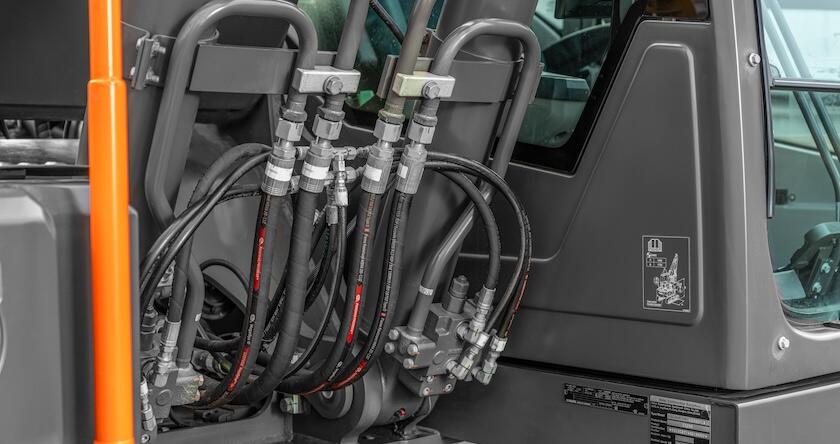
5. Protect lines from high-heat zones. Continuous exposure to extreme heat can cook the rubber compound in a hydraulic hose, causing it to harden, crack and lose its flexibility. When inspecting or rerouting lines near the engine block or exhaust system, ensure heat shields are intact and protective sleeves are properly positioned to prevent heat damage.
6. Store spare hoses away from direct sunlight and debris. Hose care starts before the line is ever installed on an excavator. If you carry spare hoses on your service trucks or store them in a shop, keep them out of direct sunlight and leave the end caps on. UV rays degrade the outer rubber over time, and airborne dirt entering an uncapped hose will immediately contaminate your hydraulic pump once it’s installed.
Get an exact factory fit.
When it’s time to replace a line, a generic hose that simply matches the diameter really isn’t enough. If you run Volvo machines, they operate at precise pressure thresholds and utilize specific routing paths to avoid pinch points. Using genuine Volvo hydraulic hoses ensures your replacement will match the exact pressure rating, multi-wire braid configuration and factory-engineered length needed to keep your excavator running safely.

