Buy or Rent Construction Equipment? Find Out Using Simple Math

According to the American Rental Association, the equipment rental penetration rate hit an all-time high of 57% in 2024. That means the majority of contractors aren’t just adding to or replacing their owned fleets — they’re strategically using rentals to supplement them.
So, how do you decide when to invest in a new piece of equipment to keep long term and when to rent a machine just to conquer the summer rush? One simple metric can give you a clue: your machine utilization rate.
Key takeaways:
- Your owned equipment forms the core backbone of your business. Heavy equipment rentals provide the flexibility to scale up during peak seasons without tying up capital.
- Calculating your construction equipment utilization rate helps you make mathematically sound decisions about your machines.
- Hitting at least the 60-70% utilization threshold is a strong indicator that purchasing a machine will deliver the best ROI.
Build a core and flex fleet strategy.
If you run a small business, your owned equipment is the backbone of your work. These are the primary, everyday machines you use to build equity and prove your company’s capabilities. Buying is always the goal for these essential assets.
On the flip side, renting is your strategic flex. It’s the tool you should use to take on a massive summer contract, tackle a niche job requiring specialized attachments or scale up temporarily. Flex machines allow you to grow without tying up the capital you need to expand your core construction equipment fleet.
Here’s how to calculate your construction equipment utilization rate.
To figure out if a machine belongs in your core or your flex fleet, a lot of heavy equipment managers rely on a metric called the utilization rate — it’s a fairly common equation.
Here’s the simple math you can use to evaluate your summer equipment needs:
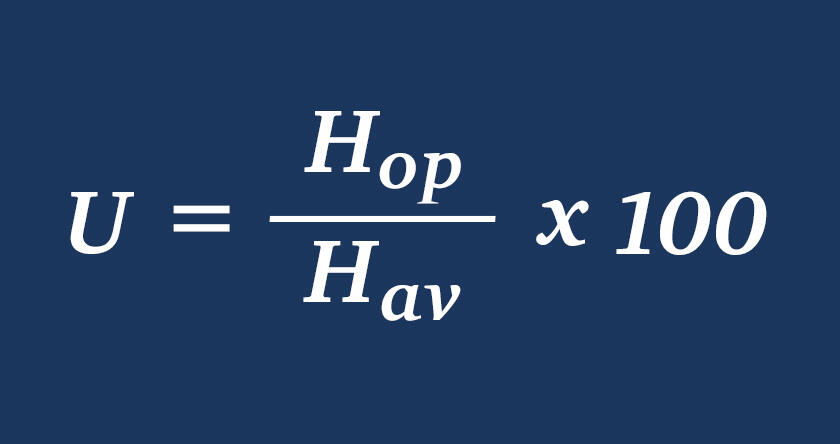
- U = Machine utilization rate (your percentage)
- H (op) = Your estimated operating hours (how many hours the machine will actually be running this year)
- H (av) = The total available working hours (the total workable hours in your business year, typically around 2,000 hours for a standard single-shift operation)
Here’s an example. Let’s say you have a specific summer utility project that requires a 20-ton excavator for 800 hours. If you work 2,000 hours a year, you divide 800 by 2,000 to get 0.40. Multiply that by 100, and your machine utilization rate is 40%.
Here’s what your construction equipment utilization percentage means.
In the heavy equipment industry, the 60-70% mark is widely recognized as the tipping point for ownership. Fleet managers and financial analysts use this benchmark because it represents the threshold where the total cost of ownership of construction equipment — encompassing depreciation, insurance and maintenance — is fully offset by machine productivity. For purposes of this blog (and to make things easier), we’ll use the 65% midpoint as our benchmark. So:
- Above 65% means it’s time to grow your core fleet: If your math puts you at or above 65%, that machine is the beating heart of your operation. Purchasing or entering a long-term lease is the smartest move to build equity and get the highest return on your investment.
- Below 65% means you should utilize your flex fleet: If your math lands below 65% — especially if those hours are crammed into a three-month summer window — renting is a highly effective way to get the job done. It keeps you agile and preserves your capital for your next big core purchase.
In our example scenario above, the utilization rate is 40%, meaning it’s likely better to rent a 20-ton excavator to tackle the job instead of purchasing a comparable machine that you’ll have long term. This is especially true if most of your work requires larger or smaller excavators.
Heavy equipment rentals protect and enhance your owned fleet.
Summer deadlines are incredibly tight. Instead of forcing your owned, midsize excavator to struggle through a heavy rock-ripping phase that causes premature wear, you could rent a larger, purpose-built machine for a few weeks. This protects the lifespan of your owned machine from abuse.
Renting is also the ultimate paid demo before you buy. If you’re eyeing a new piece of electric heavy equipment or a larger wheel loader for your permanent fleet, renting allows you to prove the fuel efficiency and cost-per-ton improvements on your actual jobsite before making the long-term investment. Renting essentially gives you the ability to test-drive machines with all the modern technologies that you currently may not be using. And if you like the new tech, maybe a purchase down the road is in order.
Balance your construction equipment fleet to maximize your profitability.
A successful equipment strategy isn’t about choosing between renting and buying. It’s about using both to maximize your profits. Do the math to build a strong core fleet and use rentals to flex your way through a profitable summer. With research from McKinsey and other industry analysts showing that up to 90% of construction projects exceed their budgets — often by an average of 28% — leveraging a flex fleet is one of the smartest ways to protect your capital while still hitting your summer deadlines.
Contact your local Volvo dealer to discuss your upcoming summer projects and they can work with you on the best path forward considering your machine utilization rates and the type of work you primarily do. You can also learn more with our guide on rent, lease, buy or equipment as a service options.


