7 Ways to Trench Faster Without Compromising Safety

The challenge isn’t just digging fast, it’s digging right — minimizing risk and ensuring machine uptime to meet those tight daily deadlines. It’s always important to follow Federal OSHA, state and local trenching requirements as they apply to your situation. And to help you out further, here are seven practical, field-tested ways to maximize your excavator trenching speed without compromising the safety of your crew or the integrity of the jobsite.
1. Get the right bucket for the job. Think of your excavator bucket as the handshake between your machine and the material. Using a general-purpose bucket for a precision trench may slow you down and waste fuel. Consider these:
- Trenching buckets: These are typically narrower and longer than standard buckets, designed for clean, deep cuts — our cable bucket CAX is a great example. Buckets like these reduce over-digging to minimize the amount of material you need to backfill later, helping improve efficiency as you’re wrapping up a utility installation.
- Rocker vs. smooth: For tough, compacted material, a heavy-duty bucket with teeth is essential for breaking ground efficiently. For softer soils or precision work, a smooth-lipped bucket provides a cleaner final trench.
- Quick couplers: These minimize the downtime between tasks. The ability to quickly swap from a narrow trenching bucket to a grading blade for cleanup — or to a breaker for rock — keeps your project moving.
2. Master spoil placement and management. Improper spoil placement can jeopardize productivity and safety. A messy jobsite can make for an unsafe, inefficient one.
- Keep it clear: The spoil pile should be placed a safe distance from the trench edge. It’s not only a crucial excavation safety regulation to prevent collapse but also ensures clear, safe access for personnel, trench boxes and backfill material.
- The double-cut technique: When trenches are deep, don’t try to place all the spoil in one tall pile. Use the machine’s reach to create a smaller, initial pile, then swing further out to create a secondary, main pile. This spreads the load and keeps the immediate trench area clear for a faster workflow.
3. Utilize the right trench shielding (trench box). Trench boxes and shoring are a must for excavation safety when you dig deep enough to require them. They also contribute to speed by giving operators and workers confidence that the walls won’t collapse and the jobsite won't be shut down.
- Sizing and placement: Ensure your trench box is correctly sized for the work area and the machine’s lifting capacity. An incorrectly sized box that’s too wide forces you to excavate unnecessary material.
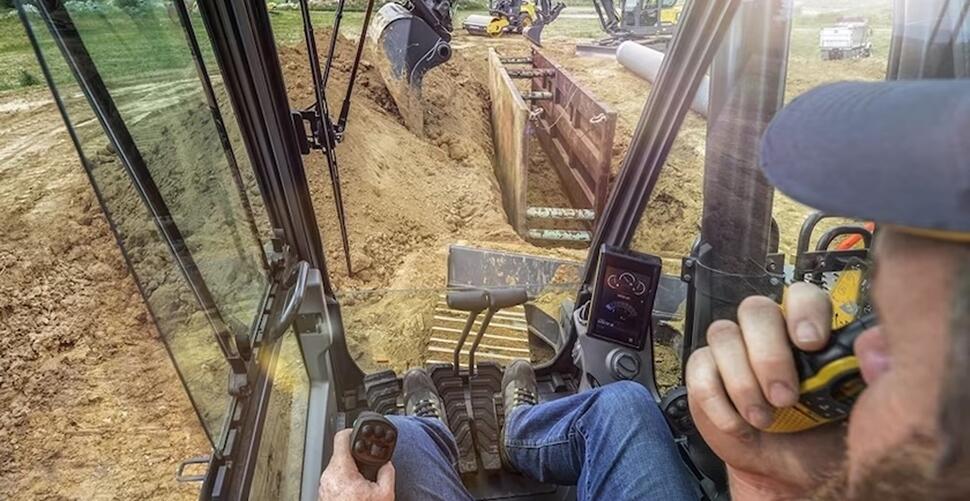
4. Leverage your excavator’s work modes. Understand when to switch between different excavator work modes — it’s key to maximizing speed and fuel efficiency. The secret lies in understanding the hydraulic relationship between flow (speed) and pressure (force/power).
- Mass digging (prioritize flow): If you have an initial, high-production phase of trenching and excavation, you’ll want maximum hydraulic flow to achieve the fastest possible cycle times — dig, swing and dump quickly.
- Precision work (prioritize pressure and control): When you get to the final pass — grading the trench bottom or setting a pipe — precision is essential for safety and quality. A lower power mode is ideal because it gives you reduced hydraulic flow, resulting in slower, smoother movements. And remember, these excavator work modes still maintain the necessary system pressure to ensure you have the digging force and lifting power required for the task without sacrificing control.
5. Practice clean and efficient truck loading. Even the fastest trencher can be slowed down by inefficient material loading and hauling.
- Position for efficiency: Keep your dump truck or haul unit positioned close enough to the trench to minimize your swing arc, but far enough away to stay safe, prevent trench cave in and clear of the spoil pile. The less time you spend swinging, the more time you spend digging.
- Load from the corner: When loading a truck, start from the corner closest to the truck cab and work your way back. This ensures an even load distribution and prevents the operator from having to shift the truck to fill the front evenly.
6. Embrace machine control and grade technology. In utilities, unforeseen site challenges are the fastest way to derail a project and miss a deadline. Hitting grade the first time eliminates costly and time-consuming rework.
- On-board guidance: Technologies like Volvo Dig Assist with In-Field Design allow you to instantly create or import a 3D design and track your bucket position in real-time. This is especially helpful for excavator trenching depth and slope, ensuring the line is perfectly on grade.
- Faster final grade: With on-board grade control, you eliminate the need to constantly stop the machine, climb out, check the grade with a laser or rod and climb back in. It keeps the bucket moving and the project on schedule, which is key in time-sensitive utility work.
7. Conduct daily pre-work planning and trenching safety checks. Nothing kills uptime and speed like a breakdown or an accident. A few minutes of pre-planning is the fastest way to save hours of downtime.
- Site survey: Walk your site before the first bucket drops. Be sure to locate all utilities and spoil areas, and establish your egress/ingress points for your haul trucks.
- Machine walkaround: Use an excavator prestart checklist to look at things like fluid levels, hose leaks and attachment condition to ensure maximum uptime. Machine availability is critical, and a simple check can prevent major downtime and expensive repairs later on.
By focusing on operational and safety best practices like these, you can ensure your fleet is delivering the productivity that’s often measured by completing a task by a certain time, hitting the grade accurately and doing it all with zero safety incidents.
If you’re looking for more helpful advice, be sure to check out our operator tips for excavator trenching and loading.