5 Ways to Speed Up Excavator Cycle Times in Tight Spaces

If you’re looking to shave some time off your cycles without rushing the work, here are five practical excavator operating tips for those narrow easements.
1. Tighten up your swing arc. In a cramped site, speed isn’t about how fast you can move the sticks — it’s about how little you can move the machine. If you can tuck your spoil pile or your truck in a spot that keeps your swing arc at 90 degrees or less, you’re good. Cutting out that “dead air” time during a long swing adds up to a lot more material moved by the end of the day.
2. Let technology do some of the heavy lifting. It’s hard to find seasoned operators right now. But there are machine control technologies like Volvo Dig Assist that help newer excavator operators put up veteran numbers. Use the tablet in the cab to get high-precision accuracy. It helps keep you from over-digging, which means you aren’t wasting time on rework or burning extra fuel.
3. Move from general accuracy to surgical design. Beyond just hitting your depth, you can take that precision further by using features like In-Field Design via Dig Assist. It allows you to draw your trench profile right on the in-cab screen. You can dig complex shapes around existing obstacles without needing someone in the trench with a grade stake. It’s safer, and it’s a lot faster than doing it the old-fashioned way.
You should also consider excavators with advanced features like Volvo Active Control to automate your movements. These types of technologies allow you to set a virtual fence or swing boundary that prevents your machine from hitting a building or obstacle, no matter how hard you pull the lever. This speeds up your cycle times because you don’t have to slow down or hesitate to check your clearance — you can swing with confidence knowing the machine will stop itself.
Active Control can also streamline the dumping process. You can set a specific point for the truck, and the machine will automatically swing and stop right over the bed every time. This eliminates the dead air time spent lining up the bucket, allowing you to simply pull the lever and dump.
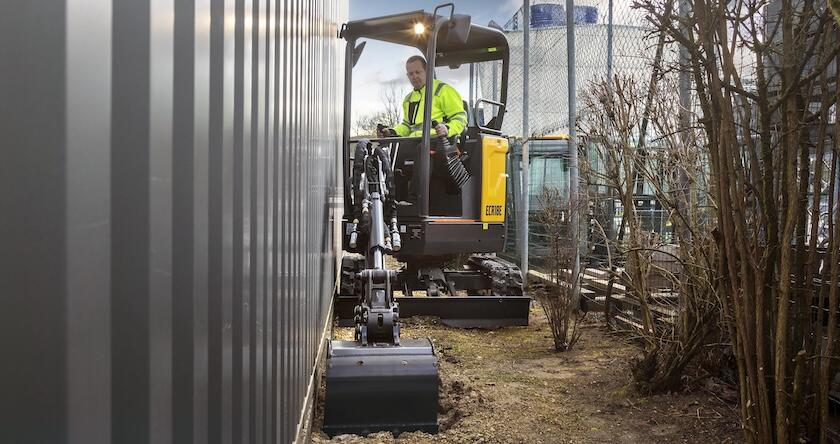
4. Use short-swing machines and offset booms. If you’re constantly worried about your tail swing hitting a wall or other object, you’ll end up working slower. This is where short-swing excavators really shine. Because the back of the machine stays within a tight radius, you can work in a single lane of traffic or up close to a structure without the stress of a potential site disruption or accident.
To get even closer, look for machines with a two-piece offset boom (shown above). While a short-swing radius protects the back of the machine, an offset boom allows you to knuckle the boom over to the left or right, enabling you to dig in line with your tracks right next to a wall. Without this, you’d have to angle the machine and dig sideways, which creates a wider trench and slows you down considerably. Combining a short-swing radius with an offset boom gives you the versatility to trench tight against a building while keeping your cab parallel to the work.
5. Keep the neighbors happy. Sometimes the biggest bottleneck is a noise ordinance that keeps you from starting early or staying late. For those finishing touches or work near occupied buildings, an electric machine like our ECR25 Electric is a good alternative to diesel. Its exterior noise levels are nearly 10 decibels lower than its diesel counterpart, meaning it sounds about half as loud. And that quieter operation is a great PR tool. When you aren’t waking up the whole block, you’re less likely to deal with complaints that can slow you down.
Excavator Cycle Times: What it comes down to.
At the end of the day, winning the contract is just the start — protecting your margins by hitting those deadlines is what keeps your business moving forward. Whether it’s through better techniques or using technology to help your crew, getting excavator cycle times down makes everyone’s life easier.
Looking for more ways to keep your crew productive and protected? Check out these 7 ways to trench faster without compromising safety for more expert advice on getting the job done right.
Danny Freeman
Sales Training and Product Support Manager
Before working for Volvo, Danny began his career within his family construction business. Currently, he’s a sales training and product support manager with several decades of construction and demolition experience.

