How to Select the Right Mining Trucks for Overburden Removal

For decades, the choice between rigid trucks and articulated dump trucks in the 50- to 75-ton class was a matter of strict application. Rigid haul trucks dominated the high-volume, well-maintained haul roads, while articulated dump trucks were the only option for soft, steep or inconsistent terrain.
Key Takeaways
- The total cost of ownership for rigid haulers must account for the substantial and continuous capital investment required to build and maintain high-quality haul roads.
- Opting for outsourced or rented articulated dump trucks (ADTs) avoids immediate capital expenditure but introduces new safety and logistical challenges from managing external crews and unfamiliar equipment.
- The inherent versatility of ADTs allows them to serve as a multi-purpose machine for general site development when not performing primary overburden removal, increasing utilization across different seasons.
Today, there are manufacturers who offer strong, high-performance solutions across the entire rigid and articulated spectrum — Volvo is one of them. And with this range of trucks, the decision is less about “which truck is better” and more about “which truck is best suited for my unique situation.”
Here are four options to evaluate when planning for overburden removal, examining how haul road investment and site conditions should drive the final equipment choice.
Option 1: Maximize productivity on well-maintained haul roads.
The scenario: You rely on the productivity and speed of high-capacity rigid haulers.
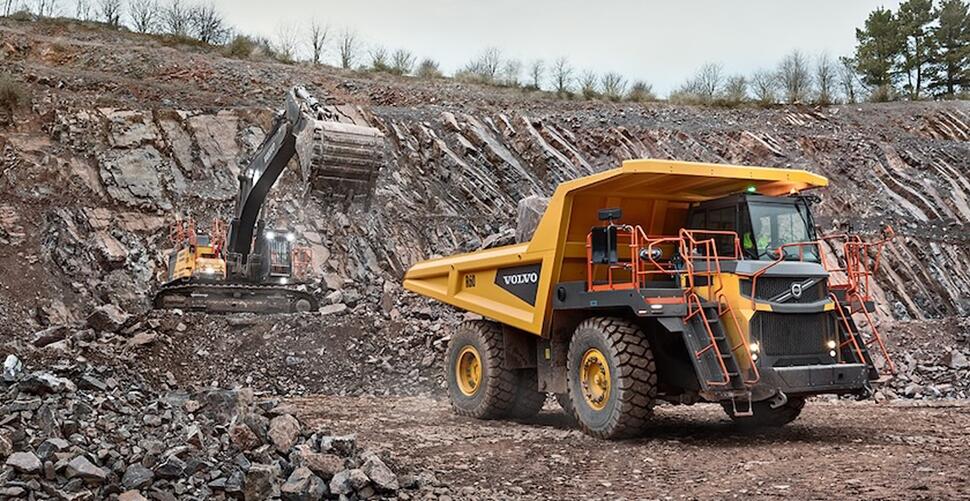
The rigid hauler is the gold standard for high-volume, long-distance hauling on firm, consistent haul roads. When conditions allow, a rigid truck offers high payloads and faster cycle times. To achieve this efficiency, however, the haul road infrastructure must be in place.
The consideration: To gain access to the overburden mining area with a rigid truck, a haul road is required. This road must be stable, firm and meticulously maintained to prevent machine damage, reduce tire wear and ensure safe operation at high speeds. The cost of building and maintaining these roads is a major expense for mines, but it’s an investment necessary to maximize the rigid truck’s throughput.
I should also mention that rigid haulers are somewhat more sensitive to weather. Some trucks can be limited in their ability to operate in highly adverse conditions, such as thick mud. While they offer superb cost-per-ton in optimal conditions, this limitation can lead to periods of downtime if severe weather hits.
This option is best for: Sites with long cycles, large volumes and a firm commitment to high-quality road construction and maintenance. Rigid haulers offer exceptional efficiency when deployed in their preferred environment.
Option 2: Outsource to a third-party fleet.
The scenario: You want to avoid equipment ownership and leverage the off-road capability of articulated haulers without investing in a fleet.
A popular alternative is to hire a third party with an existing fleet of articulated dump trucks to manage the overburden removal. This approach is common because articulated haulers can access the overburden without the need for extensive, stable haul road construction. Their permanent all-wheel drive and superior suspension allow them to traverse soft ground, steep grades and rough terrain.
The consideration: The cost of hiring a third party depends on your overall planning — some companies remove overburden once or twice per year, while others contract year-round services. The primary benefit is flexibility and immediate application. You avoid the capital expenditure of buying new machines, as well as the burden of maintenance and staffing.
The main drawback is safety and site familiarity. Bringing outside workers and unfamiliar equipment onto the site requires tight coordination, which can introduce new safety risks and logistical challenges.
This option is best for: Mines with inconsistent overburden removal schedules or those that want to test the capabilities of articulated haulers before committing to ownership.
Option 3: Rent articulated haulers for short-term use.
The scenario: You want the benefit of off-road flexibility while keeping the work in-house.
A cost-effective option that takes advantage of articulated haulers’ off-road benefits is a short-term rental. Operators can rent machines once or twice per year, or as needed, to remove the overburden themselves.
The consideration: This approach saves you from having to bid out the work (Option 2) and keeps your existing workforce in control of the operation. However, it requires having properly trained personnel on staff or reliable contract hires available only when you need the machines. A poorly trained operator can cause significant damage or inefficiency, offsetting the savings.
If your crew is familiar with operating articulated equipment, this option provides excellent operational flexibility without the long-term investment.
This option is best for: Experienced operations with skilled labor who need seasonal flexibility and want to reduce reliance on third-party contractors.
Option 4: Deploy articulated haulers for challenging conditions and versatility.
The scenario: Your site has inconsistent roads, poor weather or you need one machine to handle multiple roles.
For mines where ground conditions are poor, haul roads are highly variable or where downtime due to weather is unacceptable, the articulated dump truck remains the industry benchmark.
ADTs, like our Volvo A60 or full-suspension Volvo A50, excel where some rigid trucks might struggle or be idled. These Volvo mining trucks can work year-round in very wet and muddy conditions, increasing productivity by reducing weather-related downtime. This off-road, all-weather capability offers exceptional operational certainty.
The consideration: And on top of that, the versatility of an articulated haul truck opens the door to using the machine for other tasks when not performing overburden removal. An articulated truck can be deployed for general site development, moving soil for drainage or hauling materials in wet seasons.
The tradeoff for this versatility and off-road capability is typically less speed and potentially a higher cost-per-ton compared to a rigid truck operating in its optimal, high-speed environment.
This option is best for: Sites with steep grades, poor underfoot conditions, heavy seasonal rains or operators who need one machine capable of handling all types of terrain and duties.
The ideal truck for your overburden mining operation is dictated by your conditions.
- Do you have long, well-maintained haul roads and dry, consistent conditions? A high-capacity rigid hauler is likely your most efficient choice.
- Are your roads muddy and steep, or is year-round weather reliability your priority? The superior traction and stability of an articulated dump truck will provide the uptime you need.
By carefully evaluating the investment in your haul roads against your local climate and site flexibility needs, you can ensure you’re matching the right machine to the job.
And if you’re curious if your articulated trucks are right-sized for your excavators or wheel loaders, use our heavy equipment online pairing tool to find out fast.
Rob Palermo
Product Manager – Rigid Haulers, Haul Assist, Site Simulation
Rob has decades of experience in the construction industry, having worked in infrastructure construction and in sales roles at equipment dealerships. His current role of providing product training, support and design input allows him to bridge the gap between customers, dealers and product engineers to ensure Volvo haulers remain at the forefront of the industry.

